Key features of our Alternative Investment Funds (AIFs) Products/Recommendations
Our products are designed keeping in mind the following:

Alternative Investment Funds (AIFs) are privately pooled investment vehicles that invest in assets and strategies beyond conventional investment products. They can provide eligible investors with access to investment opportunities across private equity, venture capital, debt and other alternative asset classes.
For High Net Worth Individuals (HNIs) and Ultra High Net Worth Individuals (UHNIs), AIF investments may offer an additional avenue for portfolio diversification. However, each fund follows a specific investment strategy, risk framework and structure that investors should understand before committing capital.
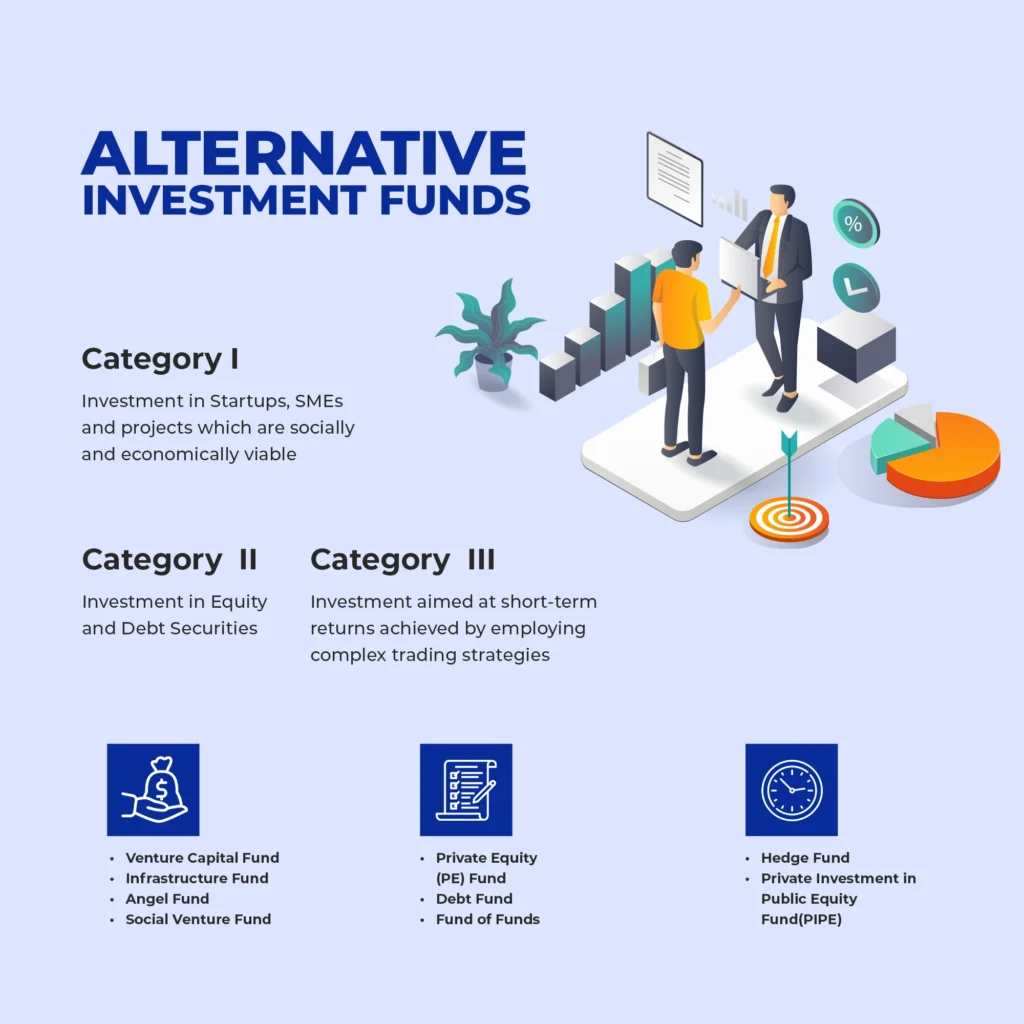
Category I AIF
Category I AIFs invest in areas such as start-ups, early-stage ventures, small and medium enterprises, social ventures and infrastructure, as permitted under the applicable regulations.
Category II AIF
Category II AIFs include funds that do not fall under Category I or Category III. They may include private equity funds, debt funds and other eligible strategies that generally do not employ leverage beyond permitted requirements.
Category III AIF
Category III AIFs use diverse or complex trading strategies and may invest in listed or unlisted securities, derivatives and other permitted instruments. These funds may use leverage, subject to regulatory conditions.
Investment Strategy
Understand the fund’s investment objective, target asset classes, strategy and approach to generating returns.
Fund Manager Experience
Evaluate the fund manager’s experience, investment philosophy, decision-making process and relevant track record.
Risk and Liquidity
AIF investments can involve market, credit, valuation and liquidity risks. Some funds may have lock-in periods or restrictions on withdrawals.
Fund Structure and Costs
Review the fund documents, management fees, performance-related fees, expenses and other applicable terms.
Investment Horizon
Alternative investments may require a longer investment horizon. Investors should assess whether the fund’s tenure and exit structure align with their financial plans.
For HNI and UHNI investors, AIFs may form part of a broader investment strategy alongside mutual funds, PMS, direct equity, debentures and other assets.
The allocation to alternative investments should be considered in relation to the investor’s overall wealth, liquidity needs, risk tolerance and investment horizon. AIFs are not suitable for every investor, and potential returns should always be evaluated alongside the associated risks.
An Alternative Investment Fund is a privately pooled investment vehicle that collects funds from eligible investors and invests according to a defined investment strategy.
AIFs are classified into Category I, Category II and Category III under SEBI regulations. Each category has different investment strategies and regulatory conditions.
The general minimum investment threshold for most AIF investors is ₹1 crore, subject to applicable regulatory exemptions and conditions. Fund-specific eligibility requirements may also apply.
AIFs may be considered by eligible HNI and UHNI investors seeking exposure to alternative investment strategies. Suitability depends on investment objectives, risk appetite, liquidity requirements and fund structure.
Mutual funds are generally designed for a wider range of investors and follow their applicable regulatory framework. AIFs are privately pooled funds with different eligibility requirements, investment strategies and risk characteristics.
AIF investments may involve market risk, credit risk, valuation uncertainty, limited liquidity and strategy-specific risks. Investors should review the fund documents before investing.
The investment horizon depends on the fund’s strategy, tenure, lock-in conditions and exit provisions. Investors should review these details before committing capital.
A group of passionate, experienced traders started the firm in 2014 with an experience of 15 years in stock market seeing the ups and downs of the market.